
Creating Equity and Accountability in Wild Places
3 MIN READ
NOLS Vice President of Advancement Cody Kaemmerlen’s Message of Social Responsibility at the Banff Mountain Film Festival
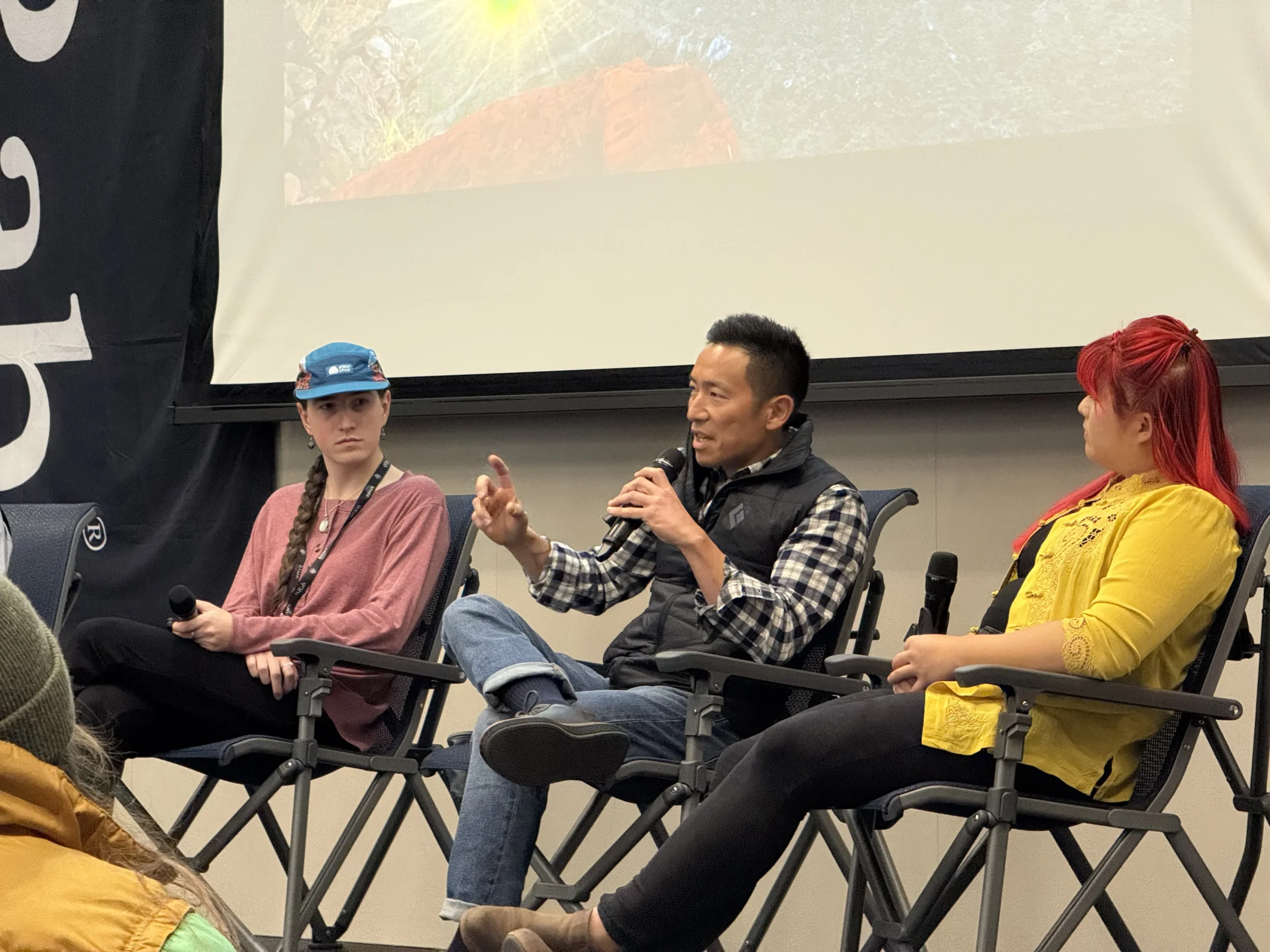
Cody Kaemmerlen speaks on the panel at the Banff Mountain Film Festival
SHARE:
SHARE:
January 26, 2026
NOLS is proud to serve as a major sponsor for the 50th Anniversary Banff Center Mountain Film and Book Festival. Vice President of Advancement Cody Kaemmerlen spoke at the festival’s premier as part of a panel entitled, “Social Responsibility in the Outdoors.”
Kaemmerlen was joined by photographer Irene Yee and Morgan Sturgess of the Alpine Club of Canada. The panel was moderated by journalist James Edward Mills, a National Geographic Explorer, who worked with NOLS and other BIPOC outdoor experts to organize Expedition Denali, the first all-Black expedition to summit North America’s highest peak. Kaemmerlen says the panel emphasized the outdoor industry’s need to advance socially responsible practices for both people and the natural environment.
“This conversation aligns with broader, industry-wide efforts to better understand the influence outdoor organizations have on consumers and employees alike,” says Kaemmerlen. “NOLS is a natural and credible contributor to this dialogue: we are an institution that develops courageous, self-aware, and resilient leaders through wilderness-based education that builds judgment, teamwork, and character.”
The panel covered wide terrain: who gets access to the outdoors, how social media shapes behavior, and what it means to actually practice environmental stewardship. It was a conversation grounded in data. Despite recent increases in participation among Black, Hispanic, and LGBTQIA+ communities, industry statistics still show a large gap between who lives in North America and who utilizes its wild places. Mills pointed out the historical forces behind that disparity; Yee spoke to the power of representation in outdoor imagery; and Sturgess reminded the audience that under-represented social groups can’t assume they’re welcome “just by existing.”
Kaemmerlen agreed, and he advocated for a more inclusive approach rooted in empathy: listen first, teach second.
“In order to understand what someone else wants, you have to talk to them without projecting your own assumptions,” he said. “Everyone engages with the outdoors differently. Equitable access means asking people how they want to experience nature—not telling them.”
He also urged the audience to reconsider what stewardship requires. “There are moments when the most responsible choice is to stay home to protect the resource or to respect the cultural significance of a place,” said Kaemmerlen. “That’s part of the conversation too.”
For NOLS, stewardship isn’t an add-on. It’s built into the curriculum: Leave-No-Trace practices, along with an emphasis on group process, risk management, and decision-making frameworks that students carry home. “We’re teaching people how to move through wild places responsibly,” Kaemmerlen said. “But we’re also building holistic leaders—whether in their communities, workplaces, or families.”
The panel also touched on public-lands policy. Kaemmerlen didn’t mince words: showing up matters. Protecting access means participating in local politics, tracking land-use proposals, and speaking up when public spaces are threatened. “Advocating for public land that is available to all of us—that’s stewardship too,” he said.
The panelists all agreed that progress has been uneven and that hard conversations are often avoided out of fear or fatigue. Yee emphasized that tough topics take time and multiple attempts: “They’re not one-comment-thread discussions,” she warned.
Kaemmerlen echoed the point. Everyone in the room, he said, had likely felt the impact of losing access to a place they cared about. “Those moments feel personal,” he said. “But if we want the next generation to have the same transformative experiences we’ve had, we have to be willing to wrestle with the hard stuff.”
He says that, for the NOLS community, the panel’s takeaway is clear: real stewardship means more than loving wild places. It requires showing up, a willingness to listen with an open heart, and committing to build an outdoor culture where all people feel empowered and inspired to become both wilderness leaders and advocates.
Sign up to read the latest each week
Subscribe to the NOLS Newsletter
Related
NOLS Announces New Members of the Board of Trustees
The Next Call to Serve
NOLS Expands Course Credit Options Through New Central Wyoming College Partnership
Keeping Public Lands Public